Let us now talk about the printing press history. Before the invention of printing, people shared knowledge and literature by painstakingly copying manuscripts. The ones who were allowed to do such work were scribes living and working in monasteries.
Doing these was difficult since it was lengthy, labor-intensive, and costly. Additionally, it also limited literacy knowledge owing to a lack of books. Everything has changed since the invention of printing. The mechanical movable type printing press revolutionized the distribution of knowledge, making it easier and faster to spread than ever before. Not only that, it also greatly affected communication and the advancement of culture.
This article will delve into the history of the printing press and how each era gave impact to human’s life. Without further ado, let’s get to it!
Table Of Content
Movable type was invented almost 400 years before the famous John Gutenberg. Bi Sheng (畢昇) created it around 1038 A.D., during the Sung dynasty. He used ceramic materials such as baked clay tiles to write each Chinese character. He created texts by arranging the types side by side on an iron plate coated with glue, wax, and paper ash. This invention changed the printing press history and had an incredible impact on the distribution of knowledge.
When Islam was at its peak (the Islamic Golden Age), scholars achieved brilliant advances in the field of papermaking. Using Chinese and Central Asian methodologies, Muslim academics perfected the process, resulting in amazing innovations that changed paper production, improving both affordability and accessibility.
In the Middle Ages, paper-making technology established by Islamic culture spread around the world via trade routes connecting India and Europe. Islamic Spain spread paper-making technology throughout the Iberian Peninsula. Since then, it has expanded throughout Europe, increasing the number of books, manuscripts, and scientific treatises. As a result, that would eventually serve as the foundation for the European Renaissance.
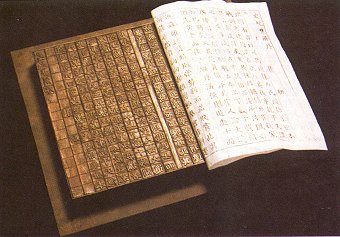
Printed in Korea in 1377, Jikji is the world’s oldest extant book created with movable metal type, predating Gutenberg’s work by decades. This demonstrates Korea’s advanced printing technology. However, while Jikji proved the viability of this method, it was Gutenberg’s printing press that would ultimately trigger a global revolution in communication and knowledge dissemination, building upon the pioneering efforts seen in Asia.
While Asia pioneered movable type, Gutenberg marked a turning point in Europe’s printing press history. Before him, hand-copied texts predominated, limiting access to knowledge. Wooden type proved ineffective due to wood’s inherent limitations: it was prone to wear, warping, and inconsistent printing. However, metal’s durability and precision facilitated Gutenberg’s breakthrough. His 15th-century press, which used a hand mold for quick type casting, oil-based ink for long-lasting prints, and a screw press for consistent quality, transformed book production. The Gutenberg Bible epitomized this breakthrough, resulting in increased book availability and lower pricing. This accessibility promoted literacy.
The quick dissemination of ideas, aided by Gutenberg’s press, sparked the Renaissance and Reformation. Scientific discoveries, such as Copernicus’, were extensively disseminated, and Martin Luther’s writings reached a large audience. Gutenberg’s creation sparked intellectual, religious, and social transformations, defining the modern period.
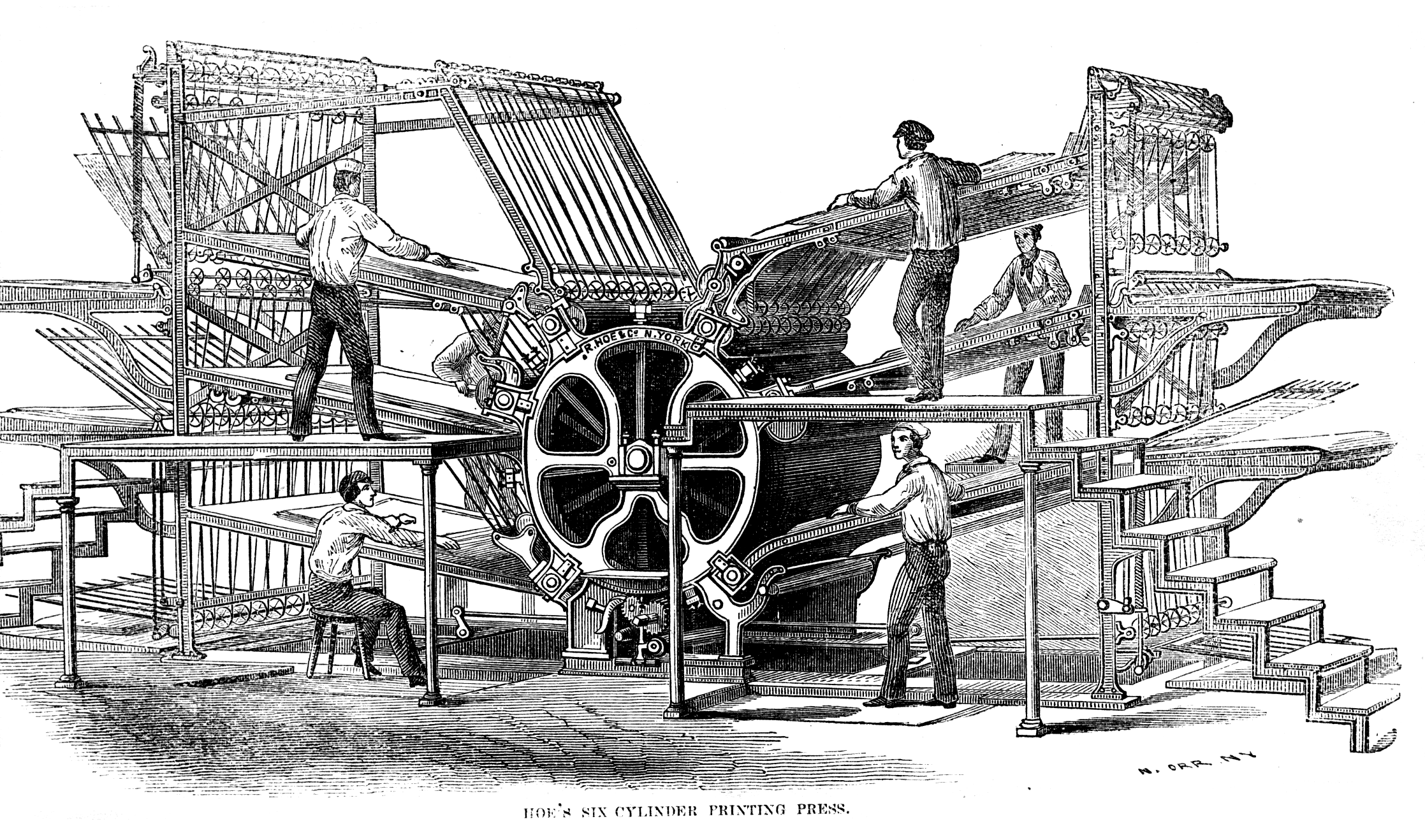
The 1800s saw a big change in printing. The rotary press came along, and it was much faster than the old flatbed presses. It used a spinning cylinder to print on long rolls of paper. This let them make tons of newspapers and magazines. Steam power made it even faster, helping people share information more easily.
In the 1900s, offset printing became the main way to print, replacing the rotary press. It used a rubber layer to move ink, which made pictures look sharper and kept the printing plates working longer. This method was cheaper and could handle many different types of printing, so it became the standard for things like magazines and posters.
Later, in the late 1900s and today, digital printing became popular. Inkjet and laser printers let people print exactly what they need, when they need it, even personalized items. These changes, from the rotary press to digital printing, have completely changed how we share information in a much more efficient way.
To summarize, the history of the printing press, as explored in this article, is a testament to human innovation and its transformative power. From the early movable type of Bi Sheng in China, through the Islamic advancements in papermaking, to the landmark contributions of Jikji in Korea, the seeds of mass communication were sown long before Gutenberg. His revolution in Europe, marked by the shift to durable metal type and the efficiency of his press, ignited a global dissemination of knowledge, fueling the Renaissance and Reformation.
The industrial era further accelerated this progress, with the rotary press and offset printing enabling mass production and higher quality prints. Today, digital printing continues to redefine the landscape, offering personalized and on-demand solutions. These advancements, from the ancient to the modern, have not only shaped the way we share information but also how we perceive and interact with the world around us.
The evolution of printing technology, as we’ve witnessed, has democratized information and fostered human connection across centuries and continents, ensuring that the legacy of the printed word endures.

